
Gratis fragt

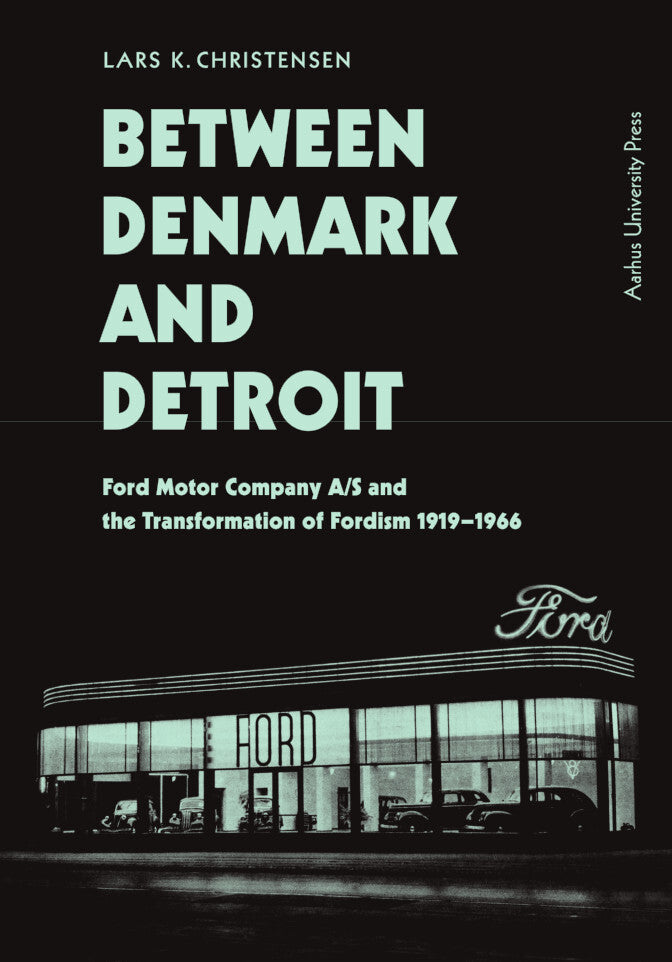
Between Denmark and Detroit

Ford Motor Company A/S and the Transformation of Fordism 1919–1966

Salgspris429,95 kr
Vælg format:
Between Denmark and Detroit

Between Denmark and Detroit

Lagerstatus kan ændre sig i løbet af dagen. Kontakt derfor butikken for at sikre, at varen stadig er på lager, så du ikke går forgæves.

Klik & hent gratis i butik, eller spar 50% på levering som medlem. (Levering fra 14,50 kr.)

Detaljer

In 1919, the Ford Motor Company – the world’s largest automobile manufacturer – decided to make a small Nordic country its bridgehead to continental Europe. Denmark was a good choice geographically and because of the country’s favourable customs policy. During the 1920s, Ford’s iconic Model T was assembled in Copenhagen, with large quantities exported from there to most of north-eastern Europe. The innovative manufacturing technology employed in Copenhagen was the same as that used in Ford’s American assembly plants, and the Copenhagen plant was actually designed by Albert Kahn – the architect behind Ford’s famous Highland Park factory in Detroit, Michigan.
The Danish Ford Motor Company successfully continued production throughout the recession of the 1930s, the German occupation of Denmark in 1940–1945 and the Cold War and economic boom of the 1950s. The Copenhagen factory closed in 1966, obliged to give way to Ford’s larger operations elsewhere in Europe.
Henry Ford’s pioneering principles of mass production went beyond mere technology. The large-scale serial manufacturing of uniform products was also a way of fulfilling his vision of an affluent consumer society. But as Fordism was relocated across the Atlantic, the rigorous discipline and fast-paced work routines applied in Detroit were challenged by local traditions, shifting market conditions and, most notably, a labour movement that was far more powerful than its American counterpart.
Between Denmark and Detroit offers a detailed history of the Danish Ford Motor Company, but the book also has a wider scope, elucidating the concept of Fordism and how it was transformed by its move across the Atlantic.
Lars K. Christensen holds a PhD in history. He is the author of several publications on labour history and industrial heritage. Presently, he is head of research and cultural heritage at the ROMU museums group.

Forfatter

Lars K. Christensen

Forlag

Aarhus Universitetsforlag

Udgivelsesdato

Opslagsdato

Varegruppe
Kulturhistorie/etnografi

Anmeldelser

Brugernes anmeldelser

Vurderet 0.0 ud af 5 baseret på 0 vurderinger

Passer perfekt sammen med

Gør dit køb komplet med produkter, der matcher i stil, tema eller stemning

Produkt 45,00 kr
Produkt 45,00 kr
Produkt 45,00 kr
Produkt 45,00 kr
Produkt 45,00 kr
Produkt 45,00 kr
Produkt 45,00 kr
Produkt 45,00 kr
Produkt 45,00 kr
Produkt 45,00 kr

Andre fandt også inspiration i

Flere produkter, som fanger nysgerrigheden hos andre kunder

Produkt 45,00 kr
Produkt 45,00 kr
Produkt 45,00 kr
Produkt 45,00 kr
Produkt 45,00 kr
Produkt 45,00 kr
Produkt 45,00 kr
Produkt 45,00 kr
Produkt 45,00 kr
Produkt 45,00 kr