
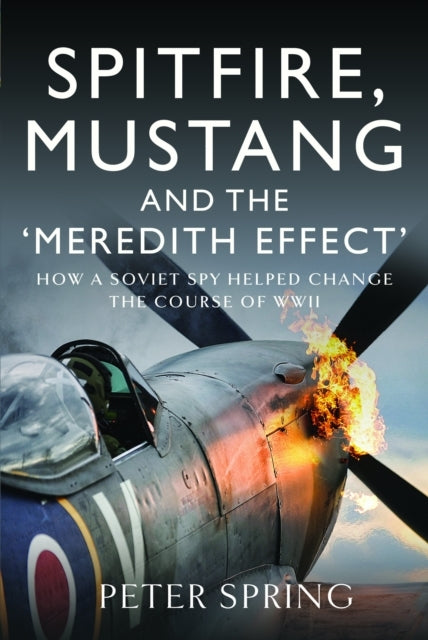
Spitfire, Mustang and the 'Meredith Effect'

How a Soviet Spy Helped Change the Course of WWII

Engelsk
Salgspris349,95 kr
Vælg format:

Spitfire, Mustang and the 'Meredith Effect'

Lagerstatus kan ændre sig i løbet af dagen. Kontakt derfor butikken for at sikre, at varen stadig er på lager, så du ikke går forgæves.

Klik & hent fragtfrit i din lokale butik eller få varen leveret. Medlemmer får halv pris på fragten

Detaljer

By the mid-1930s the obstacles to high speed that aircraft designers faced included the question of cooling the engine. This was a big challenge that those working on the new fast aeroplanes entering service as the war clouds gathered over Europe had to consider, as the drag from the system increased as a square of the speed. Ducted systems were designed which lowered drag, but these were based on the assumption that the system was cold. This ignored the potential energy from the air, heated by the radiator, for liquid-cooled aircraft, and from the discharged engine exhaust gases.It took a profoundly lateral thinker to harness the possibilities of the paradox that heat could cut the cost of cooling. That thinker was the British engineer Frederick William Meredith. A researcher at the Royal Aircraft Establishment at Farnborough until 1938, F.W. Meredith a key player in the UK’s development of the autopilot and remote-controlled aircraft. His contribution to Allied success in the Second World War was enormous – but, incredibly, he was also a known a Soviet agent.Few would doubt that the Supermarine Spitfire was a pioneering aeroplane – not because it was an all metal, monoplane with retractable undercarriage and enclosed cockpit as these were not unique – but because it was the first to incorporate a Meredith designed ducted cooling system. This was intended from the beginning to use heat to create ‘negative drag’. In practice the Spitfire’s design was flawed, as Meredith himself pointed out, and did not fully use what became known as the ‘Meredith Effect’.Meredith also made entirely overlooked but extremely important contributions to resolving the problem of how to induce air smoothly into cooling ducts at high speeds without which, as the Spitfire demonstrated, ducted cooling systems worked sub-optimally.The first aeroplane properly to exploit the ‘Meredith Effect’ was the North American P-51 Mustang, this being a very significant factor as to why it was 30mph faster than the Spitfire when both had the same Rolls-Royce Merlin engine.This book by Peters Spring examines the life of the remarkable, and controversial, F.W. Meredith, an individual who has largely been forgotten by history despite the brilliant advances he made – advances which helped the Allies win the war against Hitler’s Third Reich.

Forlag

Air World

Udgivelsesdato

Opslagsdato

Varegruppe
History & Military
Format

HARDBACK

Anmeldelser

Brugernes anmeldelser

Vurderet 0.0 ud af 5 baseret på 0 vurderinger

Mere om Spitfire, Mustang and the 'Meredith Effect'

Passer perfekt sammen med

Gør dit køb komplet med produkter, der matcher i stil, tema eller stemning

Produkt 45,00 kr
Produkt 45,00 kr
Produkt 45,00 kr
Produkt 45,00 kr
Produkt 45,00 kr
Produkt 45,00 kr
Produkt 45,00 kr
Produkt 45,00 kr
Produkt 45,00 kr
Produkt 45,00 kr

Andre fandt også inspiration i

Flere produkter, som fanger nysgerrigheden hos andre kunder

Produkt 45,00 kr
Produkt 45,00 kr
Produkt 45,00 kr
Produkt 45,00 kr
Produkt 45,00 kr
Produkt 45,00 kr
Produkt 45,00 kr
Produkt 45,00 kr
Produkt 45,00 kr
Produkt 45,00 kr