
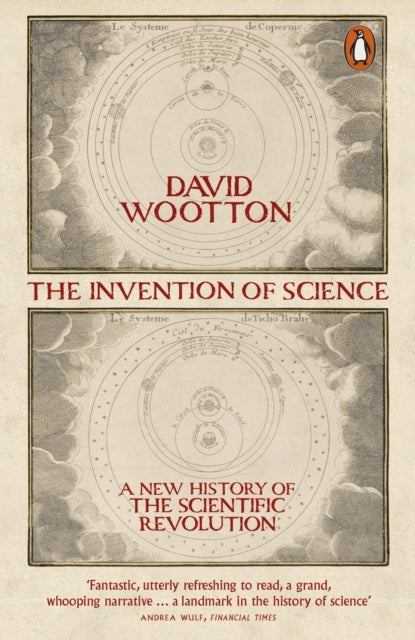
The Invention of Science

A New History of the Scientific Revolution

Af David WoottonEngelsk
Salgspris219,95 kr
Vælg format:
The Invention of Science

The Invention of Science

Lagerstatus kan ændre sig i løbet af dagen. Kontakt derfor butikken for at sikre, at varen stadig er på lager, så du ikke går forgæves.

Klik & hent fragtfrit i din lokale butik eller få varen leveret. Medlemmer får halv pris på fragten

Detaljer

We live in a world made by science. How and when did this happen? This book tells the story of the extraordinary intellectual and cultural revolution that gave birth to modern science, and mounts a major challenge to the prevailing orthodoxy of its history. Before 1492 it was assumed that all significant knowledge was already available; there was no concept of progress; people looked for understanding to the past not the future. This book argues that the discovery of America demonstrated that new knowledge was possible: indeed it introduced the very concept of 'discovery', and opened the way to the invention of science. The first crucial discovery was Tycho Brahe's nova of 1572: proof that there could be change in the heavens. The telescope (1610) rendered the old astronomy obsolete. Torricelli's experiment with the vacuum (1643) led directly to the triumph of the experimental method in the Royal Society of Boyle and Newton. By 1750 Newtonianism was being celebrated throughout Europe. The new science did not consist simply of new discoveries, or new methods. It relied on a new understanding of what knowledge might be, and with this came a new language: discovery, progress, facts, experiments, hypotheses, theories, laws of nature - almost all these terms existed before 1492, but their meanings were radically transformed so they became tools with which to think scientifically. We all now speak this language of science, which was invented during the Scientific Revolution. The new culture had its martyrs (Bruno, Galileo), its heroes (Kepler, Boyle), its propagandists (Voltaire, Diderot), and its patient labourers (Gilbert, Hooke). It led to a new rationalism, killing off alchemy, astrology, and belief in witchcraft. It led to the invention of the steam engine and to the first Industrial Revolution. David Wootton's landmark book changes our understanding of how this great transformation came about, and of what science is.

Forfatter

David Wootton

Forlag

Penguin Books Ltd

Udgivelsesdato

Opslagsdato

Varegruppe
Engelske Textbooks

Anmeldelser

Brugernes anmeldelser

Vurderet 0.0 ud af 5 baseret på 0 vurderinger

Passer perfekt sammen med

Gør dit køb komplet med produkter, der matcher i stil, tema eller stemning

Produkt 45,00 kr
Produkt 45,00 kr
Produkt 45,00 kr
Produkt 45,00 kr
Produkt 45,00 kr
Produkt 45,00 kr
Produkt 45,00 kr
Produkt 45,00 kr
Produkt 45,00 kr
Produkt 45,00 kr

Andre fandt også inspiration i

Flere produkter, som fanger nysgerrigheden hos andre kunder

Produkt 45,00 kr
Produkt 45,00 kr
Produkt 45,00 kr
Produkt 45,00 kr
Produkt 45,00 kr
Produkt 45,00 kr
Produkt 45,00 kr
Produkt 45,00 kr
Produkt 45,00 kr
Produkt 45,00 kr